
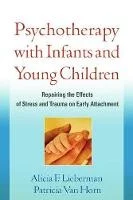
Description
By (author) Alicia F. Lieberman; By (author) Lieberman Alicia F.; By (author) Van Horn, Patricia
Short /annotation:
This eloquent book presents an empirically supported treatment that engages parents as the most powerful agents of their young children”s healthy development.
:
This eloquent book presents an empirically supported treatment that engages parents as the most powerful agents of their young children”s healthy development. Child–parent psychotherapy promotes the child”s emotional health and builds the parent”s capacity to nurture and protect, particularly when stress and trauma have disrupted the quality of the parent–child relationship. The book provides a comprehensive theoretical framework together with practical strategies for combining play, developmental guidance, trauma-focused interventions, and concrete assistance with problems of living. Filled with evocative, “how-to-do-it” examples, it is grounded in extensive clinical experience and important research on early development, attachment, neurobiology, and trauma.
Table of contents:
1. When Development Falters: Putting Relationships First 2. Coping with Danger: The Stress–Trauma Continuum 3. Practicing Child–Parent Psychotherapy: Treatment Targets and Strategies 4. The Assessment Process 5. “Not Quite Good Enough”: Perturbations in Early Relationships 6. Ghosts and Angels in the Nursery: Treating Disturbances and Disorders 7. Variations in Child–Parent Psychotherapy 8. Lapses in Attunement: Failures in the Therapeutic Relationship 9. Integrating Child–Parent Psychotherapy with Other Service Systems 10. Closing Thoughts: Taking Perspective
Review quote:
“This riveting book provides a comprehensiveof how attachment can be disrupted by stress and trauma–and how it can be mended through child-parent psychotherapy, an empirically supported treatment for infants, preschoolers, and their primary caretakers. Using the credo of ”starting with simplicity,” or developmental guidance, and moving on to behavioral and cognitive interventions and interpreting children”s and parents” inner lives, this book is rich with diverse, illuminating clinical examples. Developmental psychologists, therapists, and anyone else working with traumatized infants and preschoolers should read this gem of a book. This is a wonderful text for training advanced graduate students in developmental psychology, infant psychology, and trauma psychology.”–Judith A. Cohen, MD, Medical Director, Center for Traumatic Stress in Children and Adolescents, Allegheny General Hospital, Pittsburgh, Pennsylvania
“Lieberman and Van Horn present an extremely sensitive and comprehensive understanding of how their relationship-based approach to therapy can lead both child and parent toward positive mental health. Readers learn how to implement this important therapeutic intervention, with whom to use it, and variations in its use across different systems, such as child welfare and the judicial system. All mental health practitioners working with young children will benefit from the vivid clinical examples that bring to life the process of change. This superb book demonstrates the importance of working in the relationship in early development, and illustrates beautifully how to intervene to change maladaptive patterns.”–Joy D. Osofsky, PhD, Paul J. Ramsay Chair, Departments of Pediatrics and Psychiatry, Louisiana State University Health Sciences Center
“This long-awaited book definitively describes child–parent psychotherapy, one of the most important and effective interventions in infant mental health. The authors are master clinicians who repeatedly place the reader in the trenches of clinical dilemmas and never disappoint with their thoughtful considerations of what transpires there. With clear and illuminating prose and richly evocative vignettes, this b

Reviews
There are no reviews yet.