
Description
By (author) McQuiston Faye C.; By (author) Parker Jerald D.; By (author) Spitler Jeffrey D.; By (author) Taherian, Hessam
:
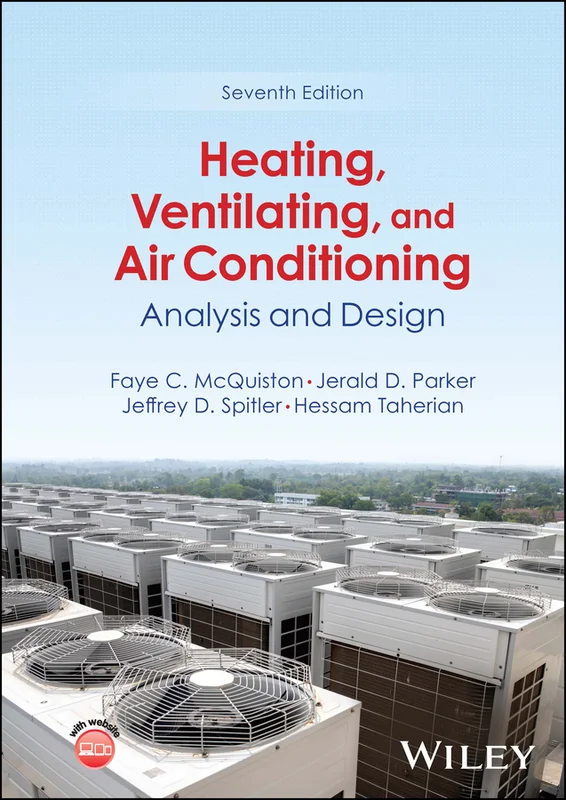
Heating, Ventilating, and Air Conditioning
The authoritative resource providing coverage of all aspects of HVAC, fully updated to align with the latest HVAC technologies and methods
Now in its Seventh Edition, Heating, Ventilating, and Air Conditioning has been fully updated to align with the latest technologies and industry developments while maintaining the balance of theoretical information with practical applications that has prepared many generations of students for their careers.
As they work through the book, students will become familiar with different types of heating and air conditioning systems and equipment, understand processes and concepts involving moist atmospheric air, learn how to provide comfort to occupants in controlled spaces, and gain practice calculating probable heat loss/gain and energy requirements. A companion website includesadditional multiple-choice questions, tutorial videos showing problem-solving for R-value calculation, and Excel spreadsheets that can be used for practice calculations.
The Seventh Edition includes new coverage of ductless A/C systems, heat exchangers and hybrid heat pumps, geothermal heat pumps, energy-efficient equipment, and UV principles of air quality treatment of airborne viruses like COVID-19.
Heating, Ventilating, and Air Conditioning includes detailed coverage of topics such as:
- Common HVAC units and dimensions, fundamental physical concepts, and system selection and arrangement
- Types of all-air systems, air-and-water systems, all-water systems, and decentralized cooling and heating
- Moist air and the standard atmosphere, fundamental parameters, adiabatic saturation, and wet bulb temperature and the psychrometric chart
- Outdoor and indoor design conditions, transmission heat losses, infiltration, heat losses from air ducts, auxiliary heat sources, and intermittently heated structures
- Heat gain, cooling load, and heat extraction rate, and application of cooling load calculation procedures
- Selection of pumps and fans, and duct HVAC sizing
Heating, Ventilating, and Air Conditioning helps prepare students for the industry by connecting the content to ASHRAE standards and by introducing coverage of software tools commonly used in HVAC design. The text is suitable for one- or two-semester HVAC courses taught at junior to graduate levels in various engineering departments.
Table of contents:
About the Companion Website xi
1. Introduction 1
1.1 Historical Notes 2
1.2 Common HVAC Units and Dimensions 3
1.3 Fundamental Physical Concepts 6
1.4 Additional Comments 18
References 19
Problems 19
2. Air-Conditioning Systems 22
2.1 The Complete System 22
2.2 System Selection and Arrangement 24
2.3 HVAC Components and Distribution Systems 27
2.4 Types of All-Air Systems 28
2.5 Air-and-Water Systems 35
2.6 All-Water Systems 37
2.7 Decentralized Cooling and Heating 38
2.8 Heat Pump Systems 41
2.9 Heat Recovery Systems 43
2.10 Thermal Energy Storage 44
References 45
Problems 46
3. Moist Air Properties and Conditioning Processes 49
3.1 Moist Air and The Standard Atmosphere 49
3.2 Fundamental Parameters 51
3.3 Adiabatic Saturation 53
3.4 Wet Bulb Temperature and the Psychrometric Chart 55
3.5 Classic Moist Air Processes 57
3.6 Space Air Conditioning—Design Conditions 66
3.7 Space Air Conditioning—Off-Design Conditions 77
References 81
Problems 81
4. Comfort and Health—Indoor Environmental Quality 86
4.1 Comfort—Physiological Considerations 87<




Reviews
There are no reviews yet.