
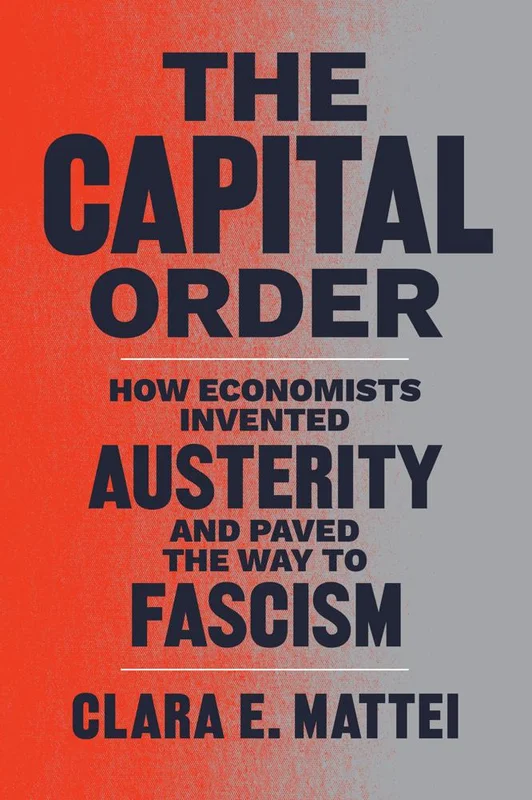
Description
By (author) Mattei, Clara E.
A Financial Times Best Book of the Year
“A must-read, with key lessons for the future.”—Thomas Piketty
A groundbreaking examination of austerity’s dark intellectual origins.
For more than a century, governments facing financial crisis have resorted to the economic policies of austerity—cuts to wages, fiscal spending, and public benefits—as a path to solvency. While these policies have been successful in appeasing creditors, they’ve had devastating effects on social and economic welfare in countries all over the world. Today, as austerity remains a favored policy among troubled states, an important question remains: What if solvency was never really the goal?
In The Capital Order, political economist Clara E. Mattei explores the intellectual origins of austerity to uncover its originating motives: the protection of capital—and indeed capitalism—in times of social upheaval from below.
Mattei traces modern austerity to its origins in interwar Britain and Italy, revealing how the threat of working-class power in the years after World War I animated a set of top-down economic policies that elevated owners, smothered workers, and imposed a rigid economic hierarchy across their societies. Where these policies “succeeded,” relatively speaking, was in their enrichment of certain parties, including employers and foreign-trade interests, who accumulated power and capital at the expense of labor. Here, Mattei argues, is where the true value of austerity can be observed: its insulation of entrenched privilege and its elimination of all alternatives to capitalism.
Drawing on newly uncovered archival material from Britain and Italy, much of it translated for the first time, The Capital Order offers a damning and essential new account of the rise of austerity—and of modern economics—at the levers of contemporary political power.
Table of contents
Introduction
Part I: War and Crisis
1 The Great War and the Economy
2 “A Wholly New School of Thought”
3 The Struggle for Economic Democracy
4 The New Order
Part II: The Meaning of Austerity
5 International Technocrats and the Making of Austerity
6 Austerity, a British Story
7 Austerity, an Italian Story
8 Italian Austerity and Fascism through British Eyes
9 Austerity and Its “Successes”
10 Austerity Forever
Afterword
Acknowledgments
Notes
Bibliography
Index
Review quote
“The Capital Order uses the historical record in Europe to argue that austerity—tightening the belt, cutting government programs—is less about budgets and debt and more about deliberately making the labor force feel insecure.”
Review quote
“Mattei reminds us that . . . austerity is a one-sided class war, conducted in numbers and defended by economists’ jargon.”
Review quote
“Illuminating . . . Any reader of The Capital Order will be struck by the contemporary resonances.”
Review quote
“In our current moment, as policymakers are once again entertaining monetary tightening as a means to impose necessary hardship & discipline on working people, The Capital Order is a potent reminder of the cruel rationality of austerity.”
Review quote
“Shocking disparities underlie economist Clara Mattei’s topical study of austerity measures promoted over the past century. Focusing on 1920s liberal-democracy Britain and fascist Italy, she argues that the profitable application of austerity to these dissimilar nations licensed its use as a capitalist ‘tool of class control.”
Review quote
“A serious economic history of the 1920s and its fiscal and credit policies, and you should not dismiss it.”
Review quote
“Brilliantly provocative . . . power



Reviews
There are no reviews yet.