
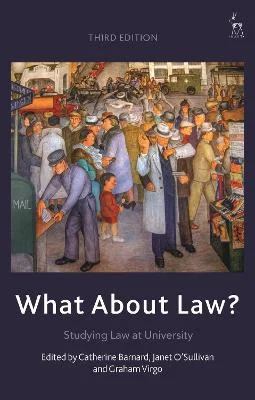
Description
By (author) Barnard Catherine; By (author) O’Sullivan, Janet; By (author) Virgo, G J
:
“”What About Law?” succeeds where so many legal guidebooks fail … [it] skilfully demystifies the law and ably proves its argument. The law is, indeed, all around us – and this book will whet your appetite to find out how and why.” –Alex Wade, The Times (of the previous edition)Law is one of the few subjects that the school leaver, choosing a degree course, will have very little real understanding of. This book comes to the rescue by clearly setting out what a prospective law student can expect and why a student should choose to study law.This new edition is updated to reflect the reality of studying law today, highlighting changes due to Brexit and reforms to constitutional law. The book covers the compulsory subjects every law student has to study: contract, criminal, property and trusts law, and brings them up to date. With a clear core structure and approach it takes a case from each of these subjects to illustrate legal issues and methodology. The writing style is accessible and has the audience – novices to law – firmly in mind.What About Law? shows how the study of law can be fun, intellectually stimulating and challenging. It introduces prospective students to the legal system, legal reasoning, critical thinking and argument. Written by a team of experienced teachers, this book should be read by every student about to embark on the study of law.
Table of contents:
1. Introduction to Law
Catherine Barnard, Janet O’Sullivan and Graham Virgo, all University of Cambridge, UKSTARTING TO THINK ABOUT LAW THE TOOLS LEGAL METHOD INTERPRETATION IMAGINATION GENERALISATION POLICY UNDERPINNING THE RULE ONE FINAL EXAMPLE CONCLUSIONS
2. Criminal Law
Graham Virgo, University of Cambridge, UKTHE ELEMENTS OF A CRIME THE REASONS FOR PUNISHMENT REASONS FOR CHARACTERISING CONDUCT AS CRIMINAL FACTS OF BROWN THE KEY OFFENCES THE ISSUE IN BROWN APPLICATION OF THE DECISION THE DISSENTING JUDGES THEORY: AUTONOMY VERSUS WELFARE SUBSEQUENT EVENTS: MOTIVE AND RISK HUMAN RIGHTS LAW REFORM CONCLUSIONS
3. Law of Contract
Janet O’Sullivan,
University of Cambridge, UKINTRODUCTION SOME CRUCIAL IDEAS ABOUT CONTRACTUAL REMEDIES THE CASE THE HOUSE OF LORDS DECISION IN MORE DETAIL WHAT HAS HAPPENED SINCE RUXLEY? WHAT IF THE BUILDER HAD SAVED MONEY BY BREACHING THE CONTRACT? CONCLUSION
4. Tort
Tony Weir, revised by Janet O’Sullivan, University of Cambridge, UKTHE MOST FAMOUS TORT CASE THE ‘DUTY’ QUESTION THE KIND OF HARM DAMAGE AND LOSS RECOVERY FOR PURE FINANCIAL HARM APPLICATION IN MCFARLANE FAIR, JUST AND REASONABLE THE REASONS GIVEN IN MCFARLANE THE SPEECH OF LORD STEYN DISTRIBUTIVE JUSTICE PSYCHIATRIC HARM EFFECT ON THIRD PARTIES TORT AS DETERRENCE DETERRENCE AND COMPENSATION TWO EXAMPLES STATUTES AND JUDGE-MADE LAW THE EFFECT OF MCFARLANE DAMAGE AND THE INVASION OF RIGHTS THE UNWANTED BABY ABROAD CONCLUSION
5. Land Law
Kevin Gray,
University of Cambridge, UKINTRODUCTION THE PROBLEM OF PROPERTY THE CASE (CHHOKAR V CHHOKAR) CONCLUSION
6. Equity and Trusts
Graham Virgo,
University of Cambridge, UKWHAT IS EQUITY? THE CONTRIBUTION OF EQUITY TYPES OF TRUST THE FACTS OF FOSKETT V MCKEOWN THE POSSIBLE SOLUTIONS IDENTIFICATION AND APPLICATION OF RULES AND PRINCIPLES CONCLUSIONS
7. Constitutional Law
Mark Elliott,
University of Cambridge, UKPROLOGUE THE MILLER II CASE CONCLUSIONS
8. EU Law, Brexit and International Trade
Catherine Barnard,
Unive



Reviews
There are no reviews yet.